Appendix D. Extension Processes
A.
Definitions
1.
A Method is said to have Plain Bob Leadheads if it can be Rotated (if needed) to start from a Change such that the treble leads at the Leadends and Leadheads, and the Leadends and Leadheads of the Method's Plain Course all occur in a Plain Course of the Method Plain Bob at the same Stage.
Example: The following table shows the Leadends and Leadheads for Norwich Surprise Minor and Plain Bob Minor. It can be seen that the two columns contain the same Rows, albeit in a different order. Norwich Suprise Minor is therefore said to have Plain Bob Leadheads.
2.
Two Hunt Bells are said to Course if they follow the same Path, and one Hunt Bell rings in the same Places as the other Hunt Bell at an interval of two Rows apart.
Example: In the Method Grandsire Doubles, the treble and the 2nd Course in the Plain Course (when the initial Row is Rounds). The same is true for Grandsire at all other Stages.
3.
The Mode of an Extension Process specifies which Places remain static, and which Places expand.
Further explanation: Mode m means that all Places up to and including Place m remain static, and all Places above Place m expand.
E.g. an Extension Process might operate by copying 4 Changes and inserting them into a Method's sequence of Changes immediately following these copied 4 Changes.
Assume the 4 Changes to be copied are x12x36.
If the Mode used is 1, the resulting sequence is x12x36x14x58. I.e. the 1 in 12 remains static, but all Places higher than 1 expand (i.e. increase) by 2 Places in the inserted section.
If the Mode used is 2, the resulting sequence is x12x36x12x58. I.e. the 12 remains static, but all Places higher than 2 expand by 2 Places in the inserted section.
If the Mode used is 3, the resulting sequence is x12x36x12x38. I.e. the 12 and the 3 in 36 remain static, and all Places higher than 3 expand by 2 Places in the inserted section.
Note that some Extension Processes operate separately on below-the-treble Places and above-the-treble Places. When Mode is used with above-the-treble Places, it may operate with respect to the highest Place (i.e. the Method's Stage) rather than Place 1. Examples of this are included in Extension Process 3 below.
B.
General
1.
Below are the Extension Processes that are currently recognised by the Central Council for extending Methods to higher Stages.
Only one Extension Process may be used to extend any one Method to a given Stage -- Extension Processes may not be combined.
Further explanation: While Extension Processes may not be combined to extend any one Method to a given Stage, different Extension Processes may be used to extend a single Method to different Stages. E.g. St Simon's Bob Doubles is extended to Triples, Caters, Cinques, etc, using Extension Process 3 below. St Simon's Bob Doubles is also extended to St Simon's Bob Minor using Extension Process 2 below (and St Simon's Bob Major is obtained from St Simon's Bob Triples using Extension Process 2, etc).
1.
Extension Process 1
Process 1 keeps the Length of the Plain Lead constant. The resulting Extension is two Stages higher than the Parent Method.
1.
Prerequisites
The prerequisites for this Extension Process are as follows:
- The Parent Method is a Method with no Hunt Bells, or a Hunter (including a Differential Hunter) with a Hunt Bell that has a Little Path.
- The Parent Method does not use Jump Changes.
2.
Steps
The steps to implement this Extension Process are shown using the following example where Little Bob Minor is the Parent Method:
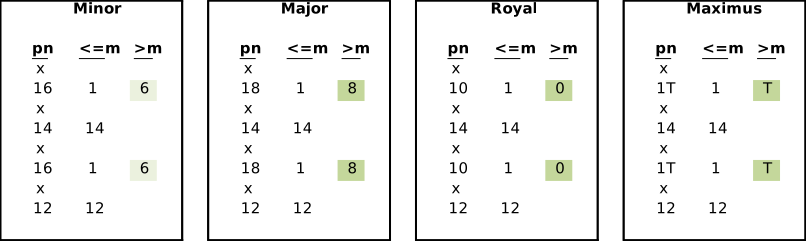
- Select a Mode m to be used, where m is greater than or equal to 1, and less than the Stage of the Parent Method. In the example above, the selected Mode is 4.
- Divide the place notation (shown in column pn) of the Parent Method into Places Made up to and including the Mode, and Places Made above the Mode. These Places are entered in the columns headed <=m and >m respectively.
- Then recombine the Places in column <=m and column >m to obtain the place notation for the Extension to Major.
- The above can be repeated to obtain additional Extensions in steps of 2 Stages, as shown above for Royal and Maximus.
3.
Requirements
An Extension produced using Extension Process 1 is only valid if:
- The Extension has the same number of Hunt Bells as the Parent Method, unless the Parent Method only has Hunt Bells and has no Working Bells, in which case the Extension also only has Hunt Bells.
- If the Parent Method comprises two or more Cycles of Working Bells of equal size, the Extension has this same feature.
- If the Parent Method has Plain Bob Leadheads, the Extension also has Plain Bob Leadheads. If the Parent Method does not have Plain Bob Leadheads, the Extension also does not have Plain Bob Leadheads.
- The Extension Construction used, when applied to the Parent Method in question, creates an Extension Path containing a minimum of 3 Methods (including the Parent Method) with Stages that are less than or equal to Stage 24.
4.
- The Extension Construction for referring to this Extension Process is 'EP1-m', where EP1 refers to Extension Process 1, and m is the Mode. So Little Bob Minor is extended using Extension Construction EP1-4.
- When two or more Modes produce the same Extension, the lowest Mode is designated as the Mode used. For example, Extension Constructions EP1-4 and EP1-5 both give the same Extensions for Little Bob Minor. EP1-4 is therefore designated as the Extension Construction used.
2.
Extension Process 2
Extension Process 2 extends a Parent Method that has one Hunt Bell by adding a second Hunt Bell. Both Hunt Bells in the Extension hunt one Place further from the lead than the Hunt Bell does in the Parent Method, and the Hunt Bells Course in the Extension. The resulting Extension is one Stage higher than the Parent Method, and the Length of the Plain Lead is increased by 2 Changes.
1.
Prerequisites
The prerequisites for this Extension Process are as follows:
- The Parent Method is a Hunter with a single Hunt Bell. The Hunt Bell follows a plain hunting Path (i.e. the Path consists of Hunting up to nth's Place, Making nth's, Hunting down to mth's Place, Making mth's). The plain hunting Path may be a Little Path or a non-Little Path.
- The Parent Method does not use Jump Changes.
2.
Steps
The steps to implement this Extension Process are shown using the following example where St Simon's Bob Doubles is the Parent Method:
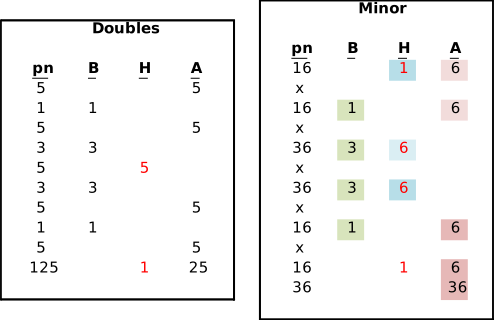
- Rotate the Parent Method (if necessary) so that the lower Place of the Hunt Bell is the Lead End Change.
- Divide the place notation (shown in column pn) of the Parent Method into Places Made below the Hunt Bell, Places Made by the Hunt Bell, and Places Made above the Hunt Bell. These Places are entered in the columns headed B, H and A respectively.
- Start by copying all the Places Made in the Parent Method (split into columns B, H and A) to the same Changes in the Extension.
- Insert a new Change at the start of the Plain Lead and another new Change at the end of the Plain Lead.
- Move the upper Place for the Hunt Bell one Place higher, and also move it one Change earlier in the Plain Lead. So 5 in the Parent Method in column H becomes 6 in the Extension one Change earlier (highlighted in ligher blue).
- Add Places for the additional Hunt Bell two changes after the Places for the original Hunt Bell. See the added 1 and 6 in column H in the example above (highlighted in darker blue), noting that the additional 1 has wrapped around to be the first Change of the Plain Lead.
- Move the Places above the Hunt Bells that are Made before the Hunt Bells reach their higher Places one Place higher, and also move them one Change earlier in the Plain Lead. So 5 and 5 in the Parent Method in column A become 6 and 6 in the Extension one Change earlier (highlighted in lighter pink).
- Move the Places above the Hunt Bells that are Made after the Hunt Bells reach their higher Places one Place higher, and also move them one Change later in the Plain Lead. So 5, 5 and 25 in the Parent Method in column A become 6, 6 and 36 in the Extension one Change later (highlighted in darker pink).
- Then recombine the Places in columns B, H and A to obtain the place notation for the Extension to Minor.
3.
- The Extension Construction for referring to this Extension Process is 'EP2', where EP2 refers to Extension Process 2. So St Simon's Bob Doubles is extended using Extension Construction EP2. This Extension Process does not use any parameters.
3.
Extension Process 3
Extension Process 3 extends a Parent Method by copying and possibly expanding some of its Changes. This Extension Process is designed to extend Parent Methods that are Hunters with a Hunt Bell that has a non-Little Path. The resulting Extension is an even number of Stages higher than the Parent Method.
Extension Process 3 is undoubtedly complex, requiring many steps to implement. However it is the Extension Process that has been used to name the greatest number of Extensions in the Methods Library, and it gives results that often correspond to how a ringer might expect a Method to extend by visual inspection of the Method's blue line.
1.
Prerequisites
The prerequisites for this Extension Process are as follows:
- The Parent Method is a non-Little Plain or Treble Dodging Method, or a non-Little Alliance Method with a Hunt Bell Path formed from these two. This Extension Process may also be applied to some other forms of Hunter with a Hunt Bell that has a non-Little Path.
- The Parent Method does not use Jump Changes.
2.
Steps
The steps to implement this Extension Process are shown using the following example where Milton Surprise Minor is the Parent Method:
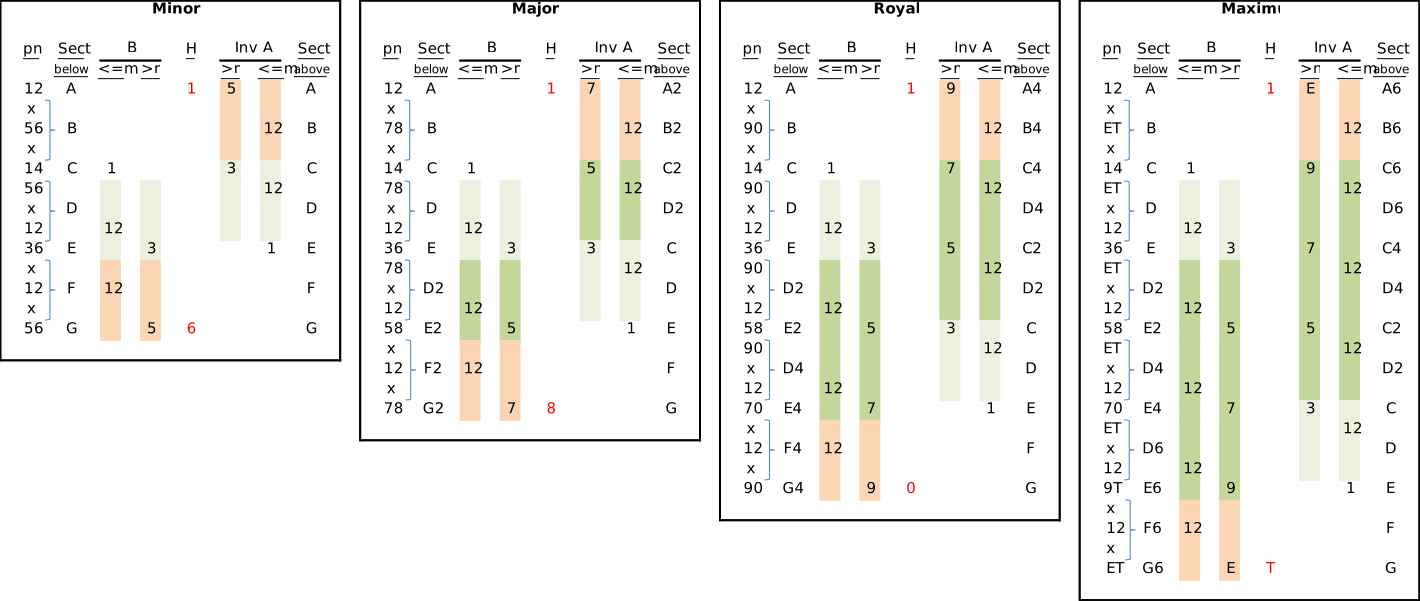
- Rotate the Parent Method (if necessary) so that the bell in 1st's Place at the initial Row (referred to as the treble for the rest of this section) is a Hunt Bell that has a non-Little Path.
- Group the place notation (shown in column pn) into sections depending on the Place of the treble, as follows:
- A -- treble leading
- B -- treble in 1-2
- C -- treble in 2-3
- D -- treble in 3-4 or lying in Singles
- E -- treble in 4-5 or lying in Minimus
- F -- treble in 5-6 or lying in Doubles
- G -- treble in 6-7 or lying in Minor
- H -- treble in 7-8 or lying in Triples
- I -- treble in 8-9 or lying in Major
- etc.
The section letters are shown in the example above under the 'Sect below' and 'Sect above' headings. Note that in the Parent Method these two columns each contain the same section letters -- this changes in the Extensions. - Select a Mode m to be used above the treble and below the treble. Mode is greater than or equal to 1, and less than the Stage of the Parent Method. In the example above, Mode 2 has been selected for both above and below the treble. However, the Modes can be different above and below.
- Divide the place notation (shown in column pn) of the Parent Method into Places Made below the treble ('B'), Places Made by the treble ('H' for Hunt Bel), and Places Made above the treble ('A').
- Then sub-divide the Places above the treble and below the treble into those that are less than or equal to the Mode, and those greater than the Mode. In the example above, since the Mode selected is 2, Places in 1st's or 2nd's are in one sub-division, and the other Places are in the other sub-division.
- Select a set of adjacent sections below the treble to copy. There must be an even number of adjacent sections in the set. In the example above, sections D and E have been chosen for copying (shaded in lighter green).
- Determine the step size. The step size is equal to the number of sections in the set selected for copying. In the example above, since two sections have been selected (D and E), the step size is 2. The step size also determines the number of Stages higher the Extension will be. In the example above with a step size of 2, Minor will be extended to Major.
- The Places in the selected sections are copied and inserted into the sequence immediately following the selected sections. For Places that are less than or equal to the Mode, no changes are made to these Places during the copying. For Places that are greater than the Mode, these are increased by the step size when copied. In the example above, the inserted sections are shown in darker green. It can be seen that Places 12 remain as 12 in the inserted sections, whereas 3 becomes 5 in the inserted sections.
- Places in the sections following the sections that have been inserted are also increased by the step size if they are greater than the Mode m. In the example above, the sections following the inserted sections are shaded in orange. It can be seen that Places 12 remain 12, whereas 5 becomes 7 in the Extension.
- The lettering of the sections following the inserted sections is modified to reflect the increase of the Places. In the example above, F and G in the Parent Method become F2 and G2 in the Extension to Major.
- The process for extending the Places above the treble is the same as below the treble, except that the copying and expanding occurs in the reverse direction (i.e. starting from the half lead and working back towards the start of the lead), and the Mode is counted from the back of the Row instead of from the front. In the example above, sections C and D are selected for copying above the treble. These are inserted earlier in the lead as C2 and D2 respectively. The sections before the inserted sections (A and B) become A2 and B2 respectively in the Extension to Major.
- Increase the upper Place of the treble by the step size and move it to the new Halflead Change. So 6 in Minor becomes 8 in Major in the example above.
- Then reinvert the Places in the two Inv A columns, and recombine the Places in all 5 columns to obtain the place notation for the Extension.
- To obtain further Extensions at higher Stages, each higher by the step size, the sections selected for copying can be inserted repeatedly, increasing the Places that are greater than the Mode by the step size for each insertion. In the example above, Royal is obtained by inserting the D, E sections below the treble twice, once as D2, E2, and again as D4, E4. To obtain Maximus, the C, D sections above the treble have been inserted three times, once as C2, D2, once as C4, D4, and again as C6, D6.
3.
Requirements
An Extension produced using Extension Process 3 is only valid if:
- The Extension has the same number of Hunt Bells as the Parent Method, unless the Parent Method only has Hunt Bells and has no Working Bells, in which case the Extension also only has Hunt Bells.
- If the Parent Method comprises two or more Cycles of Working Bells of equal size, the Extension has this same feature.
- If the Parent Method has Plain Bob Leadheads, the Extension also has Plain Bob Leadheads. If the Parent Method does not have Plain Bob Leadheads, the Extension also does not have Plain Bob Leadheads.
- The Extension Construction used, when applied to the Parent Method in question, creates an Extension Path containing a minimum of 3 Methods (including the Parent Method) with Stages that are less than or equal to Stage 24.
4.
- The Extension Construction for referring to this Extension Process is 'EP3-[Mode above the treble][sections copied above the treble]/[Mode below the treble][sections copied below the treble]'.
- EP3 refers to Extension Process 3. In the example above, the Mode was 2 both above and below the treble. Sections C and D were copied above the treble, and sections D and E were copied below the treble. The Extension Construction used in the example is therefore EP3-2CD/2DE.
5.
Other considerations
- The example above uses a set of two adjacent sections to be copied and inserted, giving an Extension that is two Stages higher. Larger sets of sections can be copied and inserted, provided the number of sections is even. For example, sections D, E, F and G could be selected for copying and inserting. Since four sections are involved, the step size is 4, and so the first Extension would be four Stages higher than the Parent Method. D4, E4, F4 and G4 sections would be inserted in the first Extension. In the next Extension (which would be eight Stages higher than the Parent Method), D8, E8, F8 and G8 sections would also be inserted, and so on. Superlative Surprise Major is an example of a Method that extends in steps of 4 Stages. The Extension Construction for Superlative's Extension Process is EP3-3ABCD/3FGHI.
- Different size sets of sections may be copied and inserted above and below the treble. For example, sections D, E, F and G could be selected below the treble, and sections A and B could be selected above the treble. In order to extend the Length of the Plain Lead by the same number of Changes above and below the treble, the sections above the treble would need to be copied and inserted twice for every one time the sections below the treble are copied and inserted. The resulting Extension in this example is four Stages higher than the Parent Method. So D4, E4, F4 and G4 sections would be inserted below the treble in the first Extension, and A4, B4, A2 and B2 sections would be inserted above the treble in the first Extension. For example, there is an Extension Process for Cambridge Surprise Major that uses steps of 2 above the treble and steps of 4 below the treble. The Extension Construction for this Extension Process is EP3-1AB/4CDEF.
- When the same results are obtained by copying different sections, designate the sections closest to the start of the lead as the ones that were copied. This ensures that whatever Stage Method is taken as the Parent Method in a set of Methods that are on the same Extension Path, the same Extension Construction will result. E.g. in the Milton Surprise Minor example above, it can be seen that if sections A and B were copied above the treble instead of sections C and D (while keeping the Mode as 2) the same results would be obtained. Therefore the Extension Construction for Milton Surprise Minor above should be described as EP3-2AB/2DE, rather than EP3-2CD/2DE. (The CD sections above the treble were used in the example above to show what happens to the AB sections above the treble in the Extension.)
- When two or more different Modes give the same results, designate the Mode used as the lowest one.
- Finally, the example and descriptions above assume the Parent Method has Palindomic Symmetry about the Leadend Change and the Halflead Change. For non-Palindromic Methods, Extension Process 3 may be applied separately in both halves of the Plain Lead, subject to the following:
- If the Places Made below the treble are Palindromic, or the Places Made above the treble are Palindromic, then an Extension Construction is selected that retains that symmetry in the Extension.
- If the Places Made above the treble in the first half of the Plain Lead have Rotational Symmetry with the Places Made below the treble in the second half of the Plain Lead, or the Places Made below the treble in the first half of the Plain Lead have Rotational Symmetry with the Places Made above the treble in the second half of the Plain Lead, then an Extension Construction is selected that retains that symmetry in the Extension.
- An example of an Extension Construction for a non-Palindromic Method is EP3-1AB/2DE/3JK/2OP. The four copied sections are respectively:
- Above the treble before the Halflead Change;
- Below the treble before the Halflead Change;
- Below the treble after the Halflead Change; and
- Above the treble after the Halflead Change.
4.
Extension Process 4
1.
Introduction
EP4 replaces the former EP1 and EP3 extension processes, and also enables a greater range of extensions beyond those provided by EP1 and EP3. It produces extensions that can both keep the lead length fixed (replacing EP1), and expand the lead length (replacing EP3). EP4 can also contract a parent method to lower stages. In addition, EP4 can produce extensions that are a single stage higher, as well as the more common scenario of producing extensions that are an even number of stages (usually two) higher.
There are three variants of EP4: single mode, double mode, and triple mode. These are described below, and examples are provided further below for each one.
- In a single mode extension, a method's places are extended together, without any further separation, in a single process.
- In a double mode extension, a method's places are separated into below-the-hunt places and above-the hunt places, with each subset extended separately. Double mode extension relies on the hunt bell having a path that can only extend in one way, such as with Plain and Treble Dodging methods.
- In a triple mode extension, a method's places are separated into hunt bell places, below-the-hunt places, and above-the hunt places, with each subset extended separately. Triple mode extension is used when it is necessary to specify how hunt bell places extend, such as with certain Alliance and Treble Place methods.
The ability to use different modes simplifies the extension process for some methods, and supports a wider range of extensions in other cases. The above variants of EP4 are all described below. It will be seen that EP4 in all variants uses the same core process to generate extensions.
In addition to mode, there are two other key parameters to specify when using EP4:
- Stage increment: This specifies the increase in the stage of the extension versus the parent, and is a positive integer, except that in contraction it is a negative integer.
- Overlap length: This specifies how the half lead length changes in the extension versus the parent. It can be zero (giving an extension where the lead length doesn't change), or a positive integer. If the overlap length is a positive integer and the stage increment is positive, then the half lead length of the extension (versus the parent) increases by the overlap length. If the overlap length is a positive integer and the stage increment is negative, then contraction is being performed, and the half lead length decreases by the overlap length.
2.
The diagram below shows EP4 used in single mode with an overlap length of zero to extend Stedman Doubles.
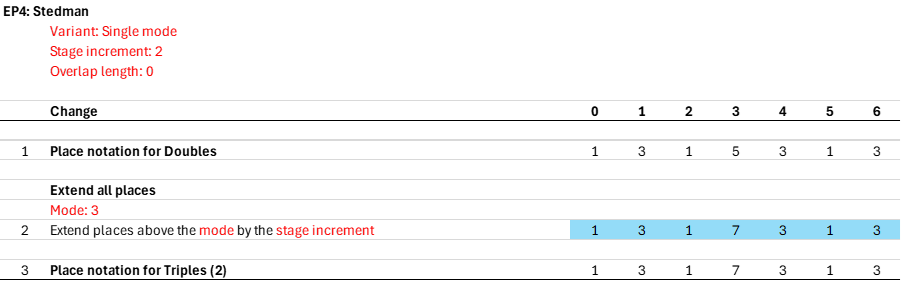
The places in line 1 above either remain unchanged in line 2 if they are less than or equal to the mode, or they increase by the stage increment if they are greater than the mode. Since the mode in this example is 3, the places in line 2 are the same as line 1, except that 5th's place in line 1 becomes 7th's place in line 2.
EP4 in single mode with a fixed lead length can be used to extend Principles and Little methods. It can't be used for Hunters with non-Little paths. But note that Principles and Little methods can also be extended on an expanding lead length basis.
3.
The diagram below shows EP4 used in single mode with an expanding lead length to extend St Clement's College Bob Minor.
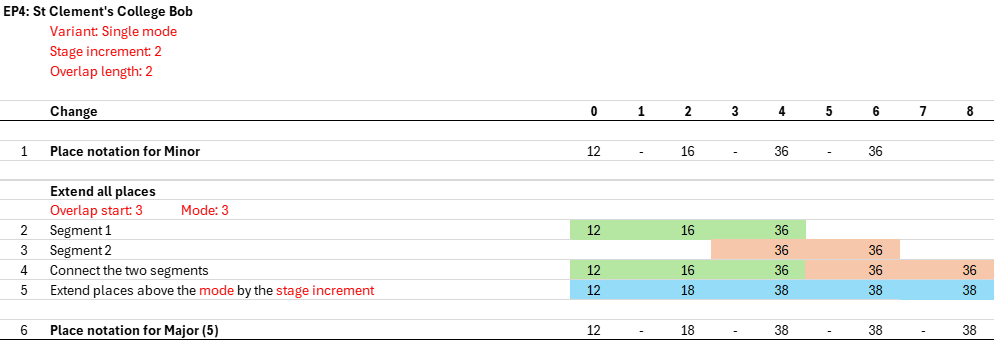
This example shows how overlapping segments are used to generate extensions. The first step is to list the place notation for a half lead of the method (line 1). By convention, the lead end change is shown first, and is labelled as change 0. The subsequent changes for a half-lead are then shown and are labelled as changes 1 to n, where n is half the lead length.
The next step is to separate the place notation into two overlapping segments, as specified by the Overlap start and Overlap length parameters. This gives segments 1 and 2, as shown in lines 2 and 3 above. These two segments are then connected as shown in line 4. Different extensions can be produced by selecting different overlap start and mode parameters.
Finally, the relevant places are extended. Since the mode is 3, the places in line 5 are the same as line 4 if they are 3rd's place or lower, otherwise they are 2 places higher.
4.
Double Mode
The diagram below shows EP4 used in double mode to extend Cambridge Surprise Minor.
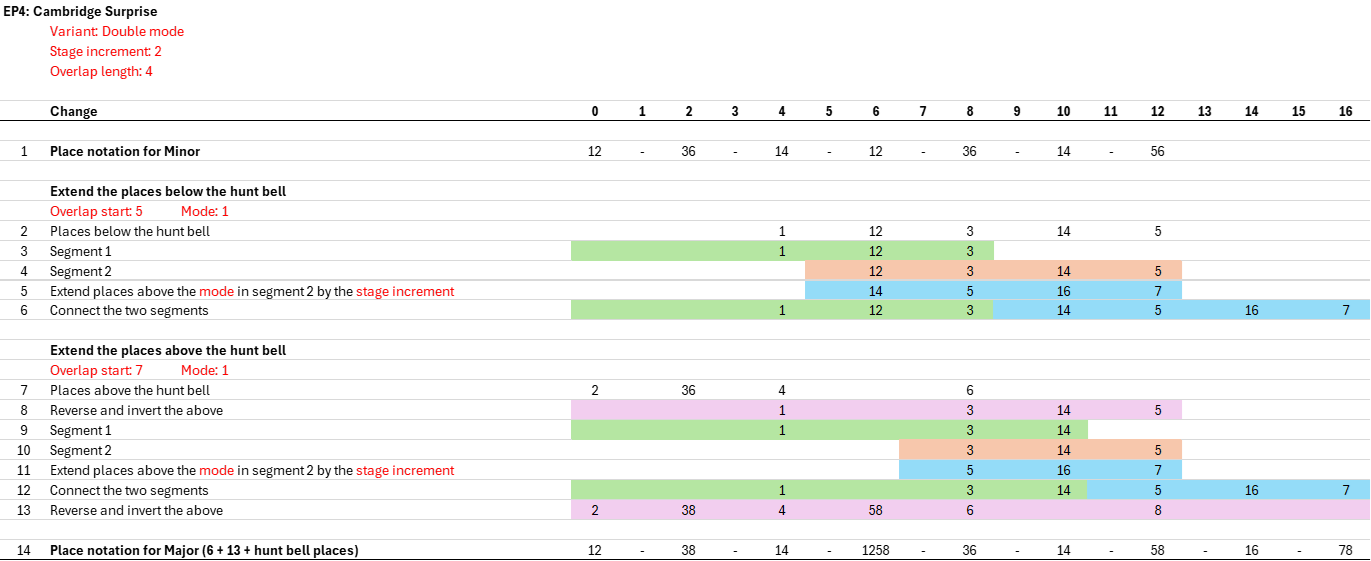
In a double mode extension, the place notation is separated into places below the hunt bell and places above the hunt bell. Each of these subsets is then processed in a similar manner to the previous example, but with two differences:
- In a single mode extension, the place notation is extended after the two segments are connected. But in a double mode extension (and also triple mode), only the places in segment 2 are extended. The extension of the places therefore occurs before the two segments are connected, as can be seen in lines 4, 5 and 6 above.
- When extending the places above the hunt bell, the first step is to reverse and invert the places (see line 8 above). This restates the places on a basis that is equivalent to places below the hunt bell, such that the same process used to extend below-the-hunt places can be used for above-the-hunt places. A final step is then added to reverse and invert the resulting extended places, to convert them back to above-the-hunt places (see line 13).
Double mode is used to extend Hunters where the hunt bell path can only extend in one way, such as with Plain and Treble Dodging methods. This can include Little Plain and Little Treble Dodging methods (the extension will be 'less Little', but will still be Little).
5.
Triple Mode
The diagram below shows EP4 used in triple mode to extend Nightingale Treble Place Minor.
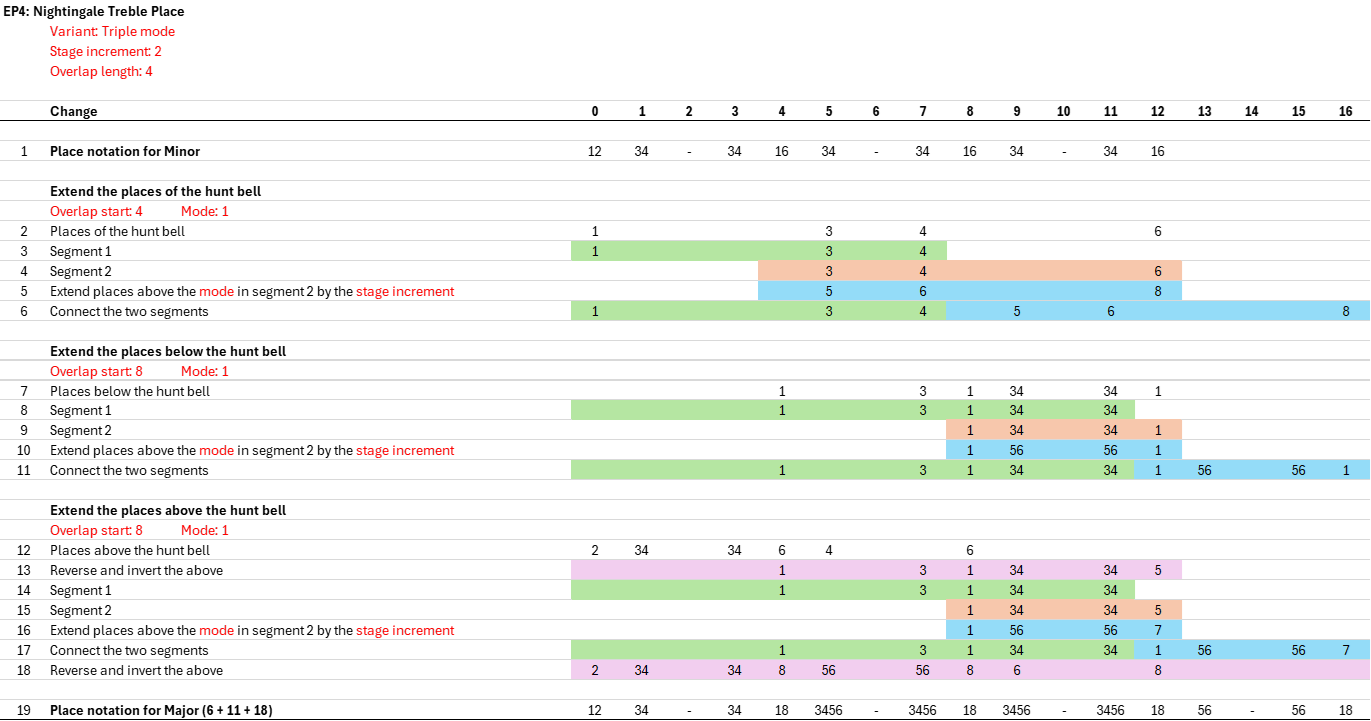
In a triple mode extension, the place notation is separated into places of the hunt bell, places below the hunt bell, and places above the hunt bell. Each of these subsets is then processed in a similar manner to the previous example.
Triple mode is used to extend Hunters where it is necessary to specify how hunt bell places extend, such as with certain Alliance and Treble Place methods. This can include Little methods where the hunt bell path could be extended in more than one way.
6.
Contraction
The diagram below shows EP4 used in double mode to contract Kent Treble Bob Minor.
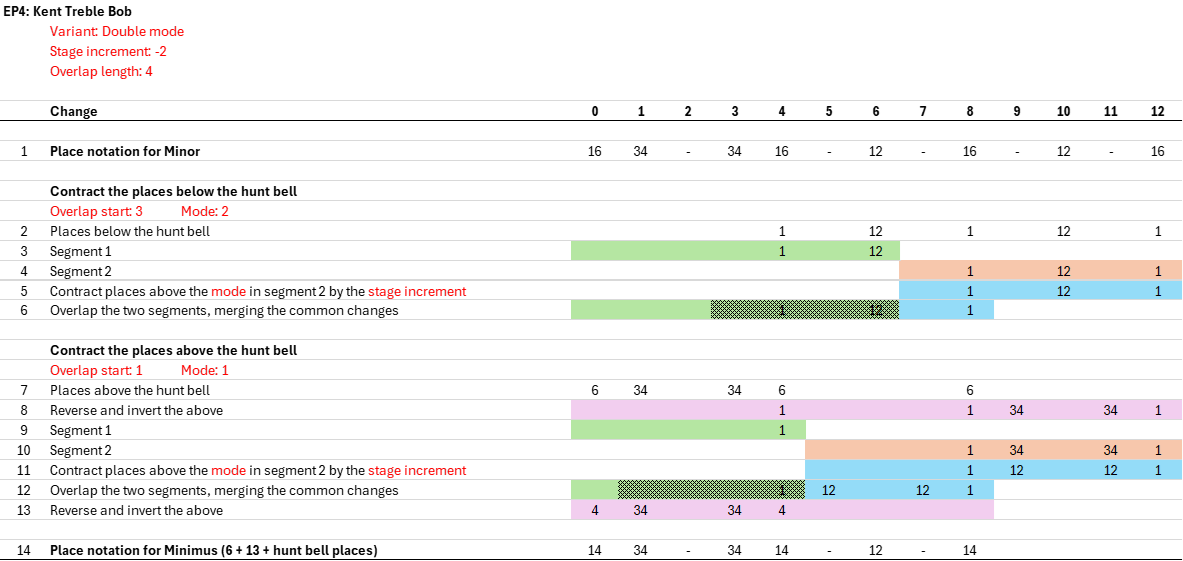
In most cases, extension works in both directions. E.g. Kent Treble Bob Minor can be extended to Kent Treble Bob Major, and Kent Treble Bob Major can be contracted with the inverse process to obtain Kent Treble Bob Minor. The parent method is usually designated as the version of a method family that has the lowest stage, and then only extensions above that stage need to be considered.
However, is some cases a method can be contracted to give a recognizable version of the method at a lower stage, but it can't then be extended back to the original stage. The reason for this is that places can 'cross the mode'. Kent Treble Bob Minimus provides a good example of this. Kent is usually extended above the treble using a mode of 1, as this causes the 3-4 Kent places to remain in 3-4 as the method is extended.
However, when Kent is contracted from Minor to Minimus, places made in 6th's become places made in 4th's. But when attempting to re-extend Minimus back to Minor, it isn't possible under EP4 to specify that the 4th's places that are part of the Kent 3-4 places should remain in 4th's, but the other places in 4th's should extend to 6th's. Contraction therefore enables designation of Kent TB Minor as the parent stage, with higher stages obtained by extension, and one lower stage (Minimus) obtained by contraction.
It will be seen from the diagram above that the contraction process is the inverse of the extension process. Crucially, contraction only works if the places that become overlapped are the same in both segments.
7.
Single Stage
The diagram below shows EP4 used with a single stage increment to extend Brampford Speke Bob Minor.
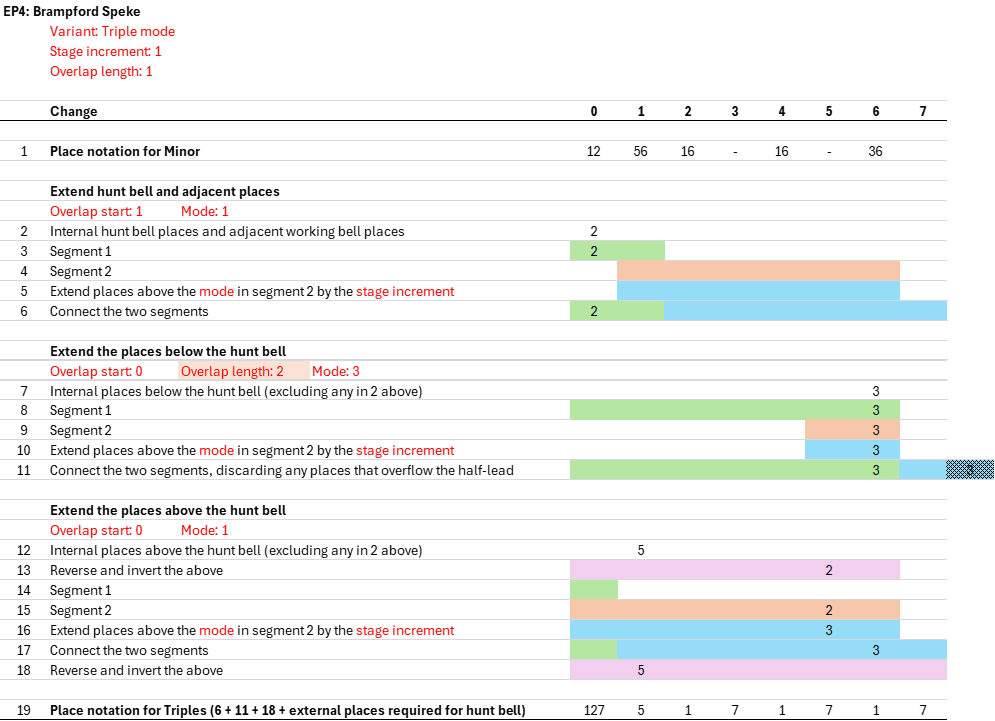
[Notes: this process requires a different overlap length for the places below the hunt bell, compared with the overlap length for the places of the hunt bell and the places above the hunt bell. It is also necessary to discard a place that overflows the half-lead. An alternative process that addresses these issues is shown below, but it requires other modifications to the general process. At the moment, the process above also includes places made adjacent to a hunt bell place as part of the process to extend the hunt bell. All to be discussed.]
8.
Single Stage — Alternative Process
The diagram below shows EP4 used with a single stage increment to extend Brampford Speke Bob Minor.
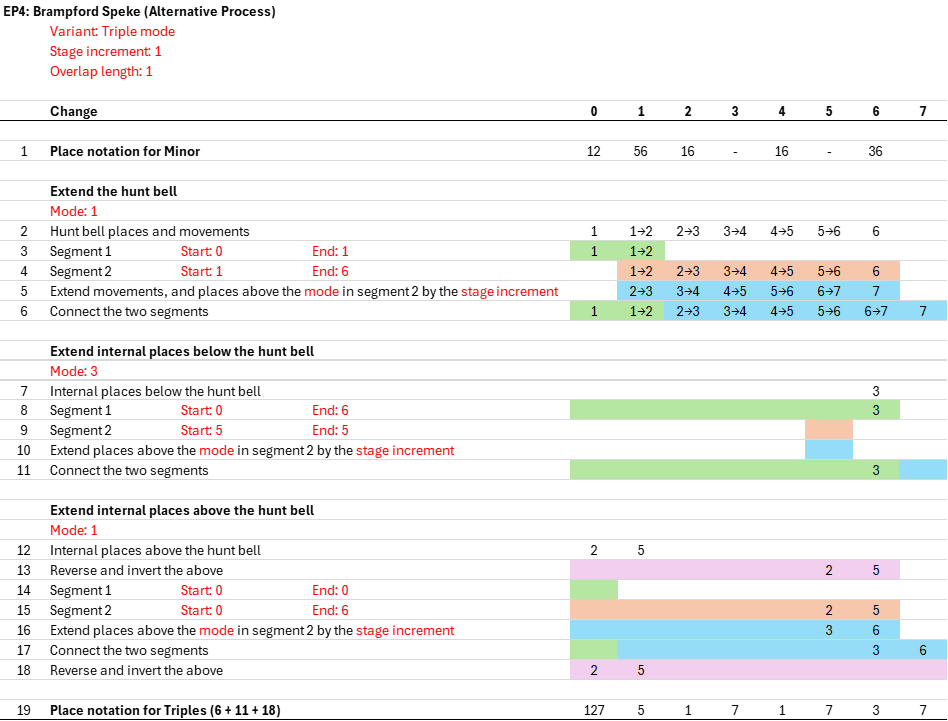
Single stage extension requires two modifications to the processes seen previously:
- Single stage extension is used primarily with Plain methods. In such methods, the presence or absence of external places (in changes where there isn't an internal place) is the result of needing to keep the hunt bell plain hunting. For example, 7th's place at change 1 in Plain Bob Triples is not derived from 6th's place at change 1 in Minor—change 1 in Minor has the cross change. Single stage extension therefore can't be derived solely from operations on the place notation—it is also necessary to extend the movements of the hunt bell. The movement notation a→b is used to mean 'In this change, the hunt bell moves from place a to place b', where a and b are adjacent places. E.g. 1→2 and 5→4. Following on from this, only internal places need to be part of the extension process, as any additional external places needed result from the hunt bell movements.
- In single stage extension, segment 2 may not continue all the way to the half lead change, and segment 1 may continue past the end of segment 2. Start and end changes for segments 1 and 2 are therefore specified individually, instead of specifying an overlap start. The values chosen for the segment starts and ends must be consistent with the Overlap length parameter.
Using these two modifications, the diagram above shows how hunt bell places and movements, internal places below the hunt bell, and internal places above the hunt bell are each extended.
9.
Additional Considerations
Multiple hunt bells: The examples above are limited to methods with no more than one hunt bell. Methods with multiple coursing hunt bells can be extended in the same way. [Add examples of Grandsire extended in steps of two stages using double mode, and also in steps of one stage using triple mode.]
Non palindromic methods: The examples above use palindromic methods. Non-palindromic methods can be extended by applying the processes above separately to each half of the method. The changes of the second half of the method are reversed prior to applying the extension operations, and the resulting extended changes are then re-reversed as the final step. [Add an example of a non-palindromic extension.]
Jump changes and dynamic methods: EP4 is not designed to be used with methods containing jump changes, or dynamic methods.
- Requirements for extensions to be valid
- The Extension has the same number of Hunt Bells as the Parent Method, unless the Parent Method only has Hunt Bells and has no Working Bells, in which case the Extension also only has Hunt Bells.
- If the Parent Method comprises two or more Cycles of Working Bells of equal size, the Extension has this same feature.
- If the Parent Method has Plain Bob Leadheads, the Extension also has Plain Bob Leadheads. If the Parent Method does not have Plain Bob Leadheads, the Extension also does not have Plain Bob Leadheads.
- The Extension Construction used, when applied to the Parent Method in question, creates an Extension Path containing a minimum of 3 Methods (including the Parent Method) with Stages that are less than or equal to Stage 24.
Standard parameters: When the same results are obtained by using different overlap starts, use the overlap start that is closest to the start of the lead. When the same results are obtained by using different modes, use the lowest mode.EP4 extension construction notation: [To be discussed.]